


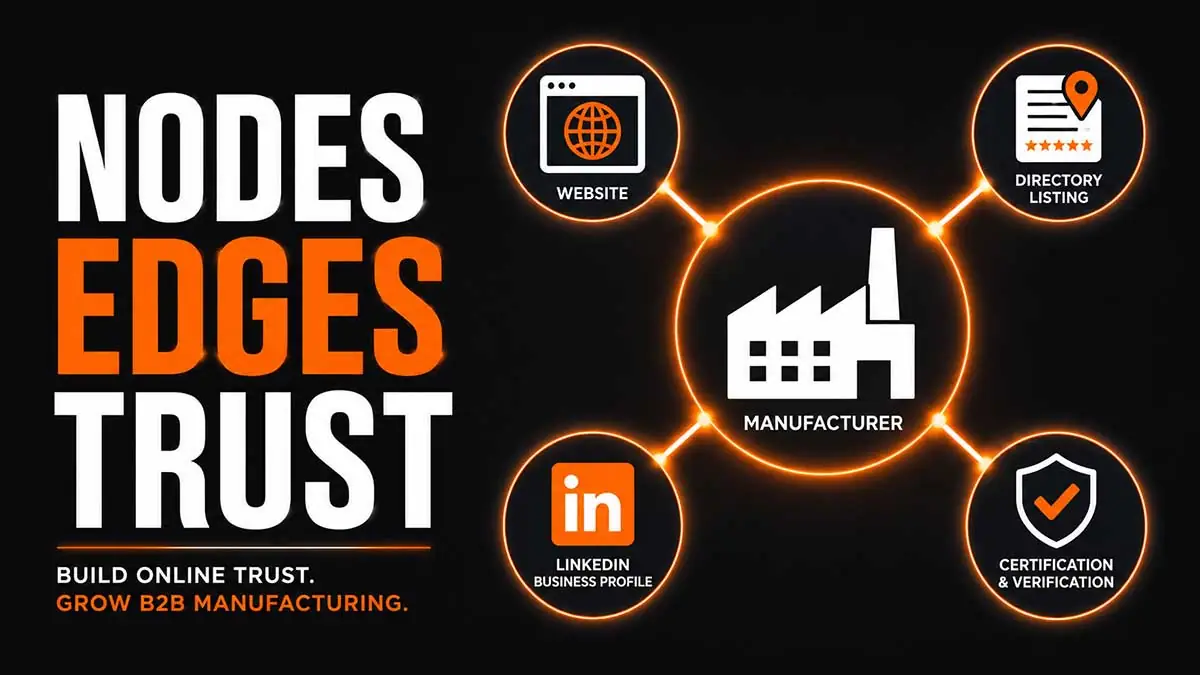
It is often difficult for manufacturers I meet to understand why they do not appear in search results more easily. They have a large factory, employees and great products. They also take part in international trade shows and their customers include large well known international brands.
Table of Contents
In the new era of AI search systems though, they don’t really exist. They don’t appear in search results for their key products and services.
This problem occurs because their online company profile is not sufficient for these systems to recommend them. In the AI search world this profile is called a “node”. In this article I will explain what that is and how it needs to connect to other nodes on the internet to make your company visible to and cited by these systems.
Your Online Company Profile – The Node
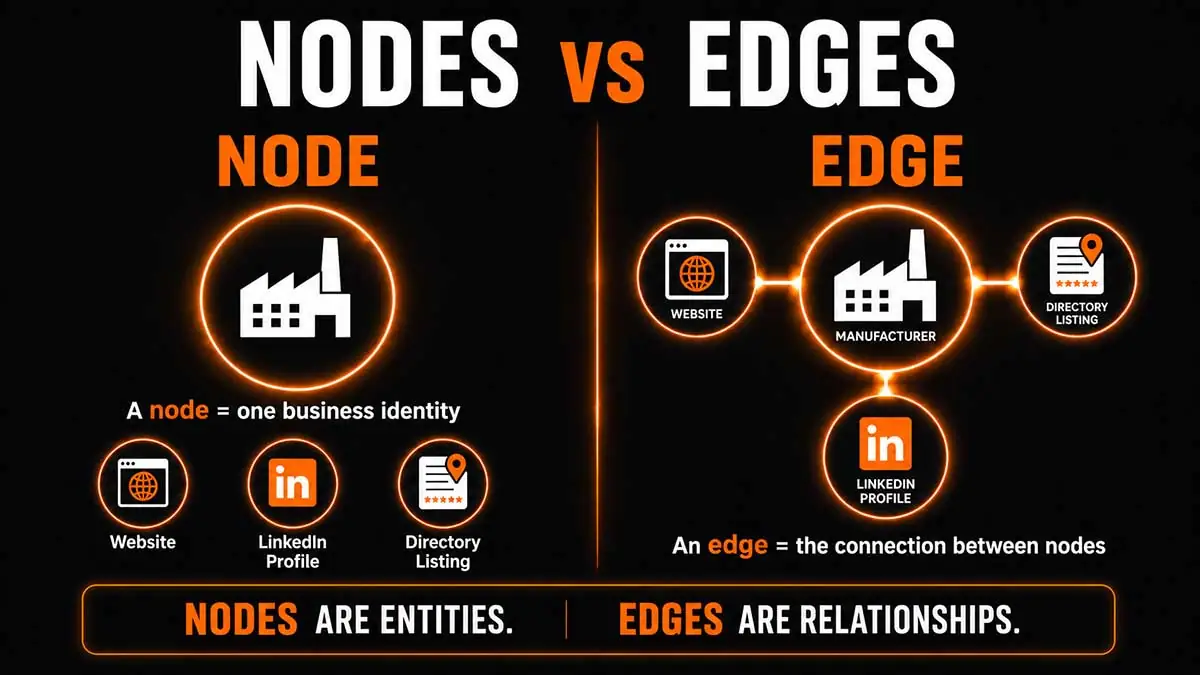
In the real world, your company is a registered business entity with physical offices and machinery. When AI search systems create a map of the online world, they try to assemble an online profile for your business. In AI search terms this is called a “Node”. If the system cannot find sufficient data online for this, then it remains blank. You could think of an empty node as a little like a Google Maps entry for a company that has no website, phone number or photos. When you see an entry like that you would be unlikely to visit or recommend that company to others.This is where entity optimization becomes critical to your company’s visiblity online.
To summarize, in manufacturing terms, your “Node” is similar to a “Digital Twin”. It is a virtual representation of your company identity online. You need to cultivate your virtual identity carefully to allow search systems to build your profile and surface your business to the right customers through online search.
The Problem With Your Website
Many manufacturers are still using old style brochure websites to represent their company. Even if you update these websites with a beautiful new design, this is still not enough to convince the AI search systems that your company is real and worth showing in search results.
This is why: Your website is only one piece of data in your node. AI systems build your node by looking at the representation of your business across the entire internet. To do this, algorithms rely on standardized, machine-readable formats outlined in the Google Search Central Guide on Structured Data. If the systems cannot cross-reference your company and your claims with these trusted data formats online, they will be unable to build a complete profile.
If the systems cannot cross reference your company and your claims with other sources online, it will not be able to build a complete profile. If the AI search systems are unable to build a clear profile, they may skip your company altogether.
Today, anyone can buy a domain and claim to be a leading manufacturer, but for AI search systems anything you say is unverified and not proof of your company’s capabilities without additional external verification.
You Need a Unique Identity Online
AI Search engines look for a unique, clear identifier for your company that is consistent. This is called “Data Consistency”. They are searching for companies as an exact string of characters.
You need to make sure that you use the exact same characters to represent your company or brand in all places online or you may fail to appear in search results.
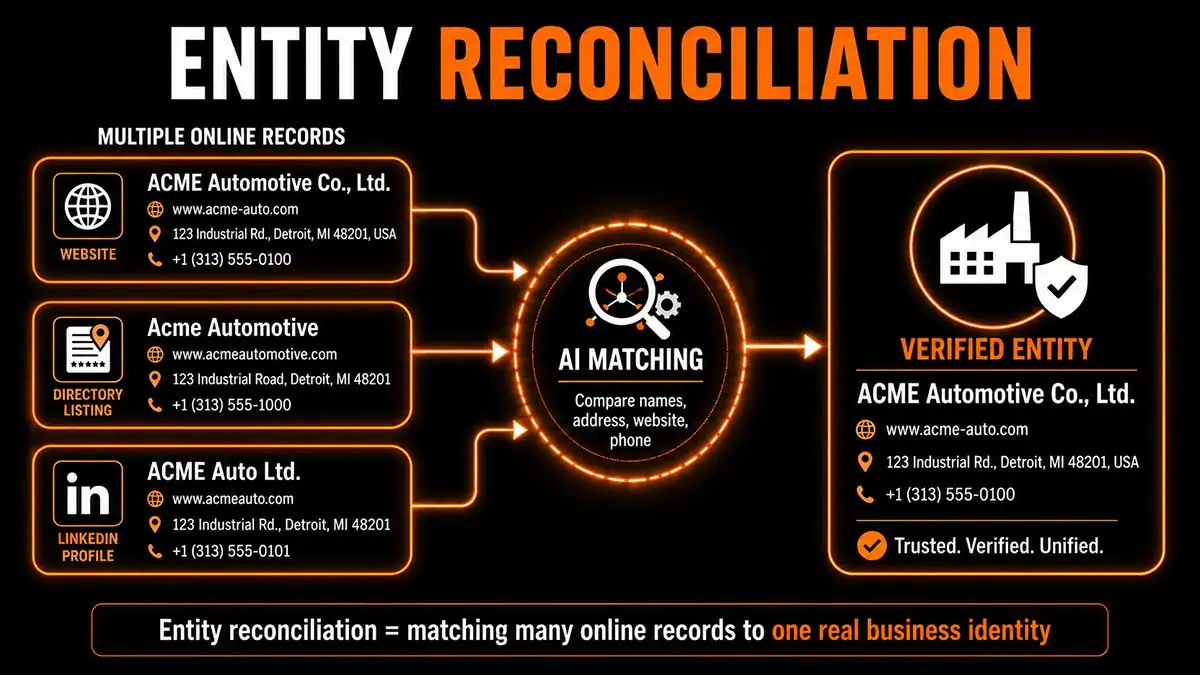
For example, using these phrases in different places online to represent your company would cause confusion:
- ACME Automotive Co., Ltd.
- Acme Automotive
- ACME Auto Ltd.
Edges – The Connection Your Company Needs to Make
In the real world, trade associations and exhibitions you join help you to promote your company and find more customers. Their websites are trusted online identities. When your company connects to these platforms or events, this creates digital relationships called “Edges”. The more high quality edges your company has, the stronger your own node will be. The authority and trustworthiness of the identities that you connect to have a direct impact on your own company’s surfaceability to AI search systems.
I have written a separate article you can read which tells you which industry directories you need to be listed in to help your company appear in AI search results.
The Technical Handshake “sameAs” Schema
This is not something that you need to do yourself, but it is worth asking your website development or marketing company to check this for you. AI search systems read a layer of code on your website which is called “Schema Markup.” Within this data layout is a specific setting known as the Schema.org sameAs property.
This is a bit like a digital staple. It allows your web developer to copy the links to your online profiles such as LinkedIn or Taiwantrade, and staple them directly into the code of your website.
When an AI search system views your website, it reads the sameAs code, follows the link directly to those platforms, and verifies your profile. This digital verification turns an isolated website into a trusted node that can be recommended by AI search systems.
Triangulation – How AI Search Systems Find The Truth About Your Business
When an international customer is evaluating a potential supplier, they need to verify that your company is who you say it is. They will “triangulate” your location, certifications and other data points to verify your online identity meets their requirements.
AI search systems do the same thing, but much faster, using a computer science process called “Entity Reconciliation.” This process is documented in the Google Search Console Entity Matching Guide. When these systems are deciding whether to recommend your company they perform an audit of your identity across the internet. They will look at your online profiles on other platforms and will attempt to exactly match (triangulate) the information in these social media or trade listings back to your official website.
The Cost of a Data Mismatch
As I mentioned earlier, we often see companies using slightly different names on different profiles or platforms. You may be “Acme Auto Co.” on one platform and then be “Acme Auto Ltd.” on another. AI search systems will flag these conflicts or inconsistencies as data mismatches, reduce their confidence in your company, and may exclude your business entirely.
If you take the time to make sure that your company name, address and phone number are written consistently across all platforms, this is a strong trust signal which can give you maximum visibility in AI search results.
Securing Your Place on the AI Shortlist
The transition from keyword search engines to AI discovery systems in the last couple of years is the biggest shift in B2B marketing in decades. For B2B manufacturers, there are only two options: either your digital Node is verified, trusted, and visible, or your massive real-world factory simply ceases to exist to modern AI Search algorithms.
Fixing your data consistency and building high-trust edges isn’t a coding or design problem, it is an administrative task which requires a careful review of everywhere your brand appears online.
If you have an internal marketing team with the time to hunt down every spelling variation and broken registry link across the web, use the principles in this article as your checklist.
If you would like to have a deeper conversation with a company that understands the challenges that you, as a B2B manufacturer, are facing in this age of AI search, then please get in touch for a free consultation.
FAQ
What exactly is Schema Markup, and how does it help AI search engines recommend my company?
Think of Schema markup as an official digital translation layer embedded behind the scenes of your website. While human buyers read your visible web design, AI algorithms rely on hidden data tags to understand what your text actually means. Instead of forcing an AI to guess whether a block of text is your actual manufacturing capacity or just a marketing quote, this code explicitly categorizes your corporate data. According to the Google Search Central Guide on Structured Data, using this structured framework eliminates machine ambiguity, allowing advanced search systems to confidently verify your business entity and map your factory’s real-world identity.
How can I verify if our marketing team or web developer has set up this “sameAs” connection correctly?
You don’t have to take their word for it or learn how to read code yourself. Google provides free, public validation tools that analyze your website exactly the way an AI algorithm does. You can instruct your web team to test your live homepage URL using the official tools on the Google Search Central Structured Data Testing Page. Running this test will instantly show you a clean visual readout of whether your underlying “sameAs” links are active, error-free, and successfully proving your digital memberships to automated search crawlers.
Which corporate profiles are the most important to link via our website’s code?
You should only link to external, high-authority platforms that independently validate your company’s existence. As outlined in the Schema.org official sameAs Property Documentation, these links function like a digital background check. For an international manufacturer, your code should target your official government registry records, your verified LinkedIn Company Page, prominent regional trade databases like Taiwantrade, or trusted global trade registries. Linking exclusively to these institutional hubs proves to the AI that your website is the official voice of a legitimate business.
Why isn’t a Google Maps link in our website footer enough to satisfy an AI’s triangulation check?
A Google Maps button works perfectly for a human customer looking for driving directions, but an AI algorithm cannot easily read a raw map coordinates link to cross-reference your corporate details. To pass an automated triangulation audit, the AI requires your location to be split into distinct, machine-readable text fields. The Google Search Central Organization Schema Guidelines point out that your address must be explicitly broken down in your code by street address, city, postal code, and country. Providing this clean, structured text allows the AI to run instant character matching against your offline legal licenses to prove your business is physically real.
What is the very first step our factory should take to secure our identity in this AI search era?
Before you try to build complex digital relationships across the web, you must establish absolute, verified ownership of your core online assets. The Google Search Central Guide on Establishing Business Details outlines the exact process for verifying your domain ownership and claiming your official local business profiles. Securing these primary verifications anchors your digital presence. It gives AI systems a trusted, legally backed foundation to reference whenever they scan the internet to audit your business capabilities.