


The way buyers find suppliers has changed significantly in the last 12 months. Where people once scanned a page of ranked links and chose for themselves, they now ask a question and receive a single synthesized answer. AI search systems build that answer from brands they can verify as real, recognized entities through corroborating signals across multiple independent sources. If your brand is not among them, it is not simply ranked lower, it is absent from the conversation entirely.
Table of Contents
For B2B companies, particularly the smaller manufacturers and sub-brands that make up so much of the sector, this raises an uncomfortable question: when an AI system is asked about your industry, does it even know you exist? The answer depends on whether these systems can verify your brand as a real entity, and that verification is something you can actively build.
In my last article I talked about what companies need to do in order to be visible and verifiable in the current digital world. This week I would like to extend that to discuss how a company should ensure, through AI SEO services that their brand is also visible in that same space. I am going to cover some of the new marketing issues that companies need to be aware of to make their brands visible to both search systems, and your potential customers.
How do search systems identify and verify your brand?
Large brands may be unique businesses with their own offices, staff and business identities. In the B2B space though, there are many small to medium enterprises that create brands which are not such clearly separate business entities. If the brand’s identity is not carefully planned and nurtured, it may be hard to persuade search systems to surface the brand in search results.
For search systems, each brand or company is a “node” which is like an online profile which identifies your brand. Each node needs connections to other nodes to create authority, build relationships and establish its identity clearly. Search systems look for these “edges” as part of a process called triangulation. What the systems discover during triangulation determines their view of your brand’s identity and authority. It is similar to the way that we often judge people by the friendships they have, and these associations are vital for your brand’s discoverability online.
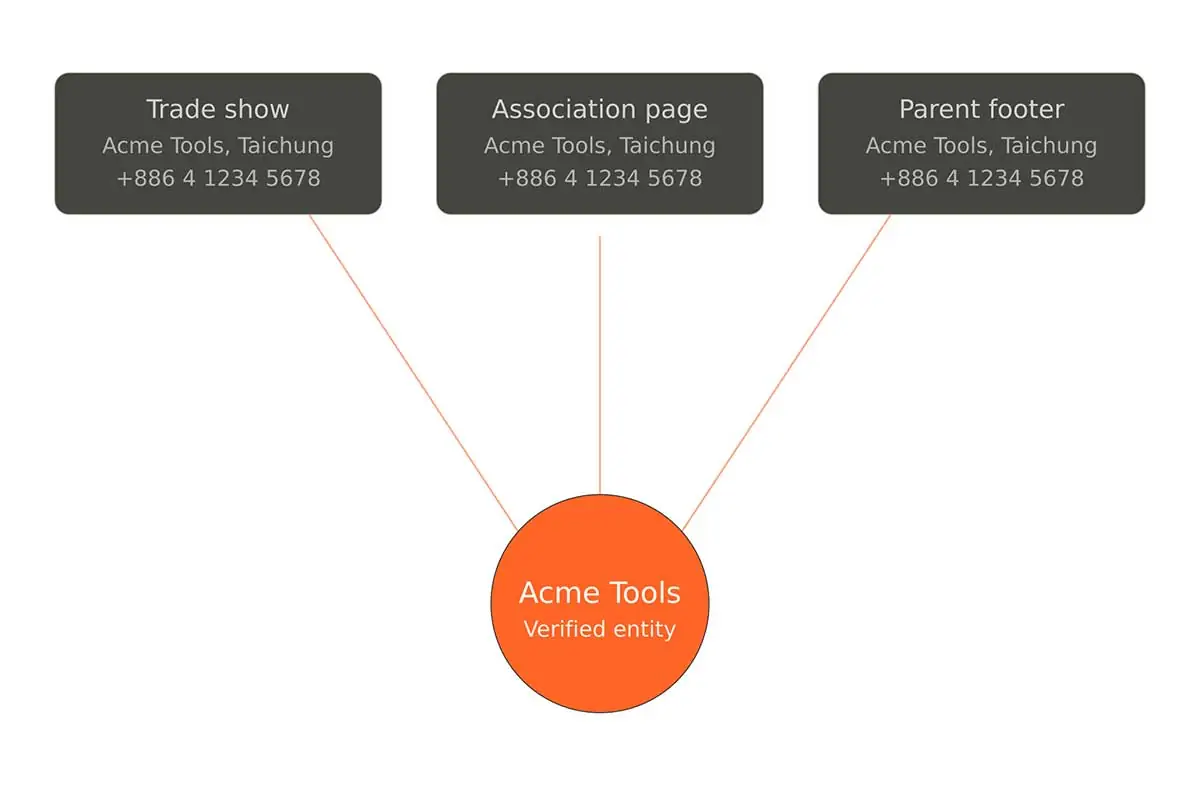
An example of triangulation
Imagine a manufacturer that makes machines under a dedicated brand name. A search system finds that brand in an exhibitor listing for a major trade show. It finds it again on an industry association’s membership page. It finds it a third time in the footer of the parent company’s website. Each mention carries the same name, address and contact details. The system now has three separate and matching edges pointing to the same node. This consistency is what builds confidence. The brand is no longer an unverified claim on its own website, it is a confirmed entity that several trusted sources recognize. This is triangulation, and it is the difference between a brand the search system surfaces to customers and one it does not.
How AI search weighs the signals
Not all signals carry the same weight, and understanding how search systems judge them tells you where to focus your effort. Three principles govern how the signals are weighed.
Consistency is more important than volume
Ten mentions that disagree on your brand’s name, address or contact details are weaker than three that match exactly. Search systems are not only counting how often your brand appears, they are determining whether the mentions describe the same entity.
This is how Google describes its own Knowledge Graph, the vast database it uses to store and connect facts about entities: a system that builds its understanding of those facts from a large number of independent sources across the web, not from any single page a company controls. The more independent sources that recognize and agree on your brand, the more confident the system becomes, and every inconsistency forces it to question which version is correct.
Independent signals are more important than those you own
A signal you do not own carries more weight than one you do. Anyone can make a claim on their own website, so a trade association listing, an exhibitor record or an editorial mention in an industry publication counts for more than your own marketing copy, because the system treats independent corroboration as far harder to fake.
Being mentioned alongside trusted sources is important
When your brand is mentioned alongside an entity the system has already verified, such as a major trade show or an established parent company, some of that entity’s confidence flows to yours. This is why the link between a sub-brand and its parent company is so valuable. The brand may be new and unknown, but its connection to a recognized parent gives the search system a trusted anchor to attach it to.
Building your brand’s online identity
To build your brand’s online identity you need to make sure that you are sending the right signals to search systems and these signals are separated into two categories: “Identity Signals” and “Relationship Signals”. In the lists below you will see the things you need to have to make your company and then your brand clearly discoverable:
We can refer to these as your identity signals and your relationship signals. Here are some examples of these signals:
Company identity signals
- Official Business Registry Filings
- Unified Core Schema Markup
- Consistent Name Address & Phone Number
- Social Media Profiles
- Press Mentions
If you do only one thing here, make your Name, Address and Phone Number identical everywhere they appear. Consistency is the foundation every other signal builds on.
Company relationship signals
- The sameAs Schema Array
- Trade Association & Chamber Memberships
- Key Executive and Founder Tie
- Major Event and Exhibition Footprints
- Trusted Vendor and Client Co-Mentions
Prioritize the trade association listings and exhibition records. These are independent sources you do not control, which is exactly why search systems trust them.
Brand identity signals
- Dedicated Website & Domain
- Unified Brand Schema Markup
- Consistent Brand Name Address & Phone Number
- Dedicated Social Media Profiles
- Independent Brand Press and Reviews
Start with the dedicated website and consistent contact details, because a brand cannot be verified as a separate entity until it has its own stable identity to point to.
Brand relationship signals
- parentOrganization Schema Properties
- Cross-Linking Site Architecture
- Affiliated Social Media Structure
- Media Co-Citation of Brand With Parent
- Shared Physical Entity Footprint
Focus first on the parentOrganization schema and the cross-linking between brand and parent, because these transfer authority from a company the search system already trusts to a brand it does not yet know.
What to do if your brand is not visible in search results
These signals compound. A single directory listing on its own does little, but each new edge you add makes every other one more credible, because the search system sees the same entity confirmed from one more independent direction. This is why discipline matters more than completeness. You may never tick off every item on these lists, and that is fine. What matters is that the signals you do build all agree with each other and all point back to the same verified identity.
Start with an honest audit of what your brand already has and where the gaps are. Your internal marketing team can handle this first review, and from there you can either build the missing signals yourself or hand the work to a specialist. At GlobalSense Marketing we do exactly this for manufacturers across Taiwan and beyond, building the entity and brand signals that make companies discoverable in AI search. The brands that win this space are not the ones with the biggest budgets or the loudest marketing. They are the ones that have been deliberately and patiently tied to a verifiable identity, so that when an AI system is asked who makes what your customer is looking for, your name is the one it trusts enough to give.
FAQ
What is an entity in the context of AI search?
An entity is a person, company, product or brand that a search system recognizes as a real, distinct thing rather than just a string of text. Once your brand is established as an entity, the system can store facts about it, connect it to other entities, and surface it confidently in answers.
What is the difference between a node and an edge?
A node is the brand or company itself, the central point the system is trying to verify. An edge is a connection between that node and another source, such as a mention on a trade association page or a link from a parent company. Nodes are what you are building. Edges are what prove they are real.
What is schema markup and do I need it?
Schema markup is structured code added to your website that tells search systems exactly what something is, for example that an organization is a brand owned by a particular parent company. It is not visible to visitors, but it removes guesswork for the systems reading your site. For B2B brands trying to be verified, it is one of the highest-value signals you can add.
What does NAP consistency mean?
NAP stands for Name, Address and Phone number. Consistency means these details match exactly everywhere your brand appears online. Even small differences, such as an abbreviated street name or an old phone number, can make a search system question whether two mentions refer to the same entity.
How long does it take to become visible in AI search?
There is no fixed timeline, because it depends on how many signals already exist and how quickly new ones are recognized. Entity verification is gradual, building as more independent sources corroborate your brand. The practical answer is that the sooner you start building consistent signals, the sooner the system has enough to trust.