


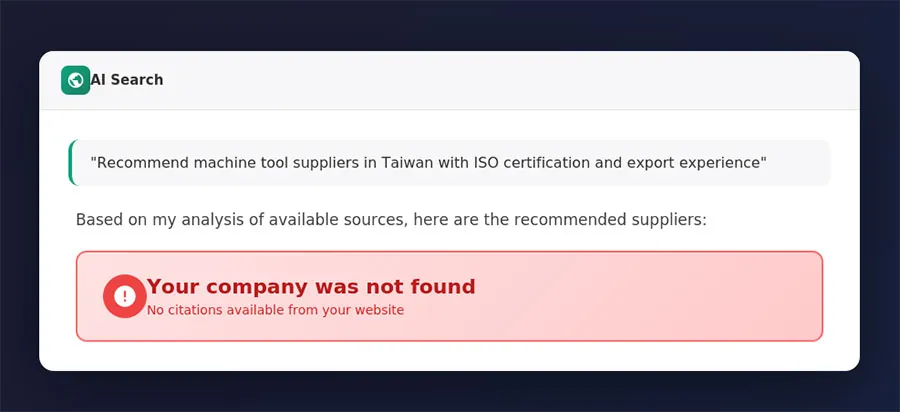
Picture this scenario. Right now, a procurement manager in Munich is typing into ChatGPT: “Recommend ISO-certified precision die casting suppliers in Asia with automotive experience.” The AI processes the request, then delivers a summary with five companies, their key capabilities, and why each might be worth contacting. Three are Chinese firms, one is Korean, one is Japanese.
Table of Contents
Your company, with its IATF 16949 certification, two decades of automotive component experience, and state-of-the-art facilities in Taichung, is nowhere to be found.
You will never know this happened. There is no missed phone call, no lost email in your spam folder, no trade show conversation that did not convert. Just silence. The inquiry went to your competitors before you even knew there was an opportunity.
This is happening every single day. International buyers are using AI to research and shortlist suppliers, and the vast majority of Taiwan manufacturers simply do not appear in the results. After twenty years helping Taiwan’s export manufacturers reach international markets, I can tell you this represents the most significant shift in B2B buyer behavior I have witnessed. And most companies here have not yet understood what it means for their business.
Key Takeaways for Manufacturing Executives
- AI search is now the second largest source of qualified B2B leads, accounting for 34% of leads from AI platforms, ahead of organic search and email marketing
- B2B buyers adopt AI search at three times the consumer rate, with 29% now starting supplier research in AI tools more often than Google
- AI systems cite only 2-7 sources per response, creating intense competition for visibility compared to traditional search results
- Content freshness directly impacts citations, with recently updated content earning 3.2 times more AI citations than older material
- Most Taiwan manufacturer websites are invisible to AI because technical content is locked in PDFs, images, and formats AI cannot read
The Numbers That Should Concern You
AI-powered search has become a primary channel for B2B buyer research. The data confirms this is not a future trend but a current reality.
How Big Is AI Search for B2B?
According to research from 10Fold Communications, AI-native platforms like ChatGPT and Perplexity have become the second most common source for qualified B2B leads, now accounting for 34% of leads from AI search platforms. That places AI ahead of organic search, email marketing, and paid advertising.
How Fast Is AI Search Growing?
Forrester’s research reveals that B2B buyers are adopting AI-powered search at three times the rate of consumers. This is not a gradual shift; it is an acceleration. Their data shows AI-generated traffic growing at more than 40% monthly, with projections suggesting it will reach 20% or more of total organic traffic by the end of 2025.
Are B2B Buyers Actually Using AI Instead of Google?
Yes. The behavioral change is already measurable. G2’s 2025 Buyer Behavior Report found that nearly eight in ten B2B decision-makers say AI has changed how they conduct research, with 29% now starting their research via large language models more often than Google. Research from Responsive found that one in four B2B buyers now use AI more than traditional search when researching suppliers, and two-thirds rely on AI chatbots as much as or more than Google or Bing.
These are not predictions about what might happen. These are measurements of what your buyers are already doing.
Why AI Changes Everything About Being Found
AI search fundamentally differs from traditional search in ways that directly impact how manufacturers get discovered by international buyers.
How Traditional Search Works
Traditional Google search gives buyers a list of ten links on page one. The buyer clicks through several websites, compares information, makes notes, and gradually builds a shortlist. You had multiple chances to be seen. Even if you were not the top result, a determined buyer might find you on page two or through a refined search. The process took time, and that time worked in your favor.
How AI Search Works
AI search works completely differently. When a buyer asks ChatGPT or Perplexity for supplier recommendations, the AI does not provide a list of links to explore. It provides an answer with suppliers already selected and compared. The AI has already done the shortlisting. Research from Princeton University shows that large language models typically cite just two to seven sources per response. That is not ten opportunities on page one; that is a dramatically smaller number of positions with dramatically higher stakes.
Why This Creates Concentrated Competition
This creates a concentration effect where a small number of companies capture most of the visibility. The gap between being cited and not being cited is not incremental; it is binary. You are either in the AI’s recommendation or you effectively do not exist for that buyer.
Why Taiwan Manufacturers Are Particularly Vulnerable
For Taiwan manufacturers, this presents a particular challenge. Most company websites here were built as digital catalogs, designed to display products rather than demonstrate expertise. Content is often translated rather than written by native speakers, which AI systems can detect and tend to deprioritize. Technical capabilities are documented in PDFs and images that AI cannot read. The websites work adequately for buyers who already know your company, but they provide nothing for AI systems trying to determine who to recommend to buyers who do not.
If you want to understand where AI search fits within a broader international marketing strategy, this guide covers the full picture: a complete guide to international marketing for manufacturers in Asia.
What AI Search Engines Actually Want
When I explain AI search optimization to manufacturing executives, I find it helps to think of your website content as a proposal. You are essentially submitting a bid to AI systems, asking them to recommend you when relevant queries come in. The more complete, credible, and accessible your proposal, the more likely you are to win.
Authority Signals
AI systems trust companies that demonstrate expertise through depth and specificity. Generic marketing language provides no signal whatsoever. When your website says “high-quality CNC machining services with fast turnaround times,” that tells AI nothing it can use. When your competitor’s website says “5-axis CNC machining centers achieving tolerances of +/- 0.005mm for aerospace aluminum alloys including 7075-T6 and 6061-T6, with full AS9100 documentation and CMM inspection reports,” that provides specific, verifiable claims AI can extract and cite.
Content Structure
AI needs to extract quotes and facts from your content. Research on AI citation patterns indicates that pages with clear heading structures are 40% more likely to be cited, and opening paragraphs that directly answer queries get cited 67% more often. If your information is buried in downloadable PDFs, locked in images, or scattered across unconnected pages, AI simply cannot use it. Your decades of expertise become invisible.
Content Freshness
AI systems prioritize recently updated content because fresh information suggests active expertise. Data suggests that content updated within the last 30 days earns 3.2 times more citations than older material. Many Taiwan manufacturer websites have not been substantively updated in years. To AI, that signals outdated information from a company that may not be actively engaged in its market.
Comprehensive Coverage
AI selects sources that provide complete answers to buyer questions. Partial information gets passed over in favor of competitors who answer the full question. If a buyer asks about suppliers with specific certifications, material capabilities, and geographic coverage, and your website only addresses two of those three elements, a competitor who addresses all three will be cited instead.
The Strategic Questions You Should Be Asking
Before you talk to your marketing team or agency about AI search optimization, there are four questions worth considering at the strategic level.
What Would a Buyer Need to Know to Recommend You?
Try this exercise: ask ChatGPT to recommend suppliers in your product category, then examine what attributes it highlights. Those are the factors AI considers important. If your website does not clearly communicate those attributes, AI cannot recommend you based on them. This is not about what you think matters; it is about what AI systems have learned that buyers want to know.
Where Are Your Capabilities Documented in Ways AI Can Access?
Many manufacturers have excellent technical specifications, but they exist only in PDF brochures, image-based diagrams, or password-protected customer portals. AI cannot read any of these. The information might as well not exist. This is a strategic issue, not a technical detail. Content accessibility is now a competitive factor.
How Does Your Content Compare to Companies AI Does Recommend?
If competitors appear in AI responses and you do not, study what they are doing differently. What depth of information do they provide? How do they structure their content? What specific claims do they make? This is competitive intelligence, and it should inform your content investment decisions.
When Was Your Website Content Last Substantively Updated?
Not when was a news item posted or a product photo changed, but when was meaningful technical or capability content added or refreshed? If the answer is “years ago,” you are signaling to AI systems that your information may be outdated. In a field where specifications and capabilities evolve, old content undermines credibility.
What You Should Tell Your Marketing Partner
Manufacturing executives who understand the strategic importance of AI visibility will typically delegate implementation to marketing partners. The challenge is knowing what to ask for. Based on what actually drives AI citation performance, here are five directives worth giving to your marketing team or agency.
Directive 1: Show Me Our Current AI Search Visibility
Before any optimization work begins, you need a baseline. Ask your marketing partner to demonstrate whether your company appears when buyers ask AI about your products and services, and how you compare to your main competitors. If they cannot show you this, they may not understand AI search well enough to help you.
Directive 2: Make Our Technical Content Accessible to AI Systems
This means converting PDF specifications, image-based content, and downloadable materials into web-based text. The goal is not to eliminate PDFs entirely, but to ensure the key information also exists in formats AI can read and cite.
Directive 3: Document What Makes Us Different With Specificity
Push back on generic claims. Replace “high quality” with specific tolerances. Replace “experienced team” with years of operation and number of completed projects. Replace “certified” with the actual certification names and what they cover. Specific, verifiable claims are what AI extracts and cites.
Directive 4: Establish a Content Update Schedule
Fresh content signals active expertise. Monthly updates at minimum, whether that means new technical articles, updated capability information, or expanded application examples. This is not about producing content for its own sake; it is about demonstrating ongoing engagement with your field.
Directive 5: Measure Citations, Not Just Traffic
Traditional web analytics tell you how many people visited your site. They do not tell you whether AI systems are recommending you to potential buyers. Ask your marketing partner to track AI visibility over time, including where and how often your company appears in AI-generated responses.
The Opportunity for Early Action
Here is what most Taiwan manufacturers have not yet recognized: the majority of your competitors have not adapted to this change either.
Why Early Movers Have an Advantage
AI citation patterns tend to persist once established. Once AI systems learn to recommend certain companies for certain queries, those patterns continue. Early movers establish authority that becomes increasingly difficult to displace. This is different from traditional SEO, where rankings fluctuate constantly. In AI search, the companies that establish citation authority now will have a significant advantage over those who wait.
Why the Investment Makes Sense
The investment required is modest compared to other business development activities. A comprehensive AI search optimization program costs a fraction of what you spend on a major international trade show, yet it works continuously rather than for three days a year. It reaches buyers at the moment they are actively researching suppliers, not when they happen to visit your exhibition booth.
Consider the comparison with trade shows. Taiwan manufacturers routinely invest NT$500,000 or more for a major exhibition, plus travel, accommodation, and staff time. That investment reaches perhaps a few hundred potential buyers over three days. Meanwhile, AI search reaches thousands of procurement professionals daily, year-round, at the exact moment they are looking for suppliers like you. The return on investment calculation has shifted dramatically, but investment patterns have not yet caught up.
The Risk of Waiting
The risk of waiting is not merely missed opportunities today. It is allowing competitors to establish the AI citation authority that will make them the default recommendations for years to come. Every month you delay is a month your competitors may be building the visibility that will be difficult to overcome later.
Your next competitor will not necessarily have better equipment, lower prices, or more impressive certifications. They will simply be the company that AI recommends when international buyers ask who they should contact. The question is whether that company will be you.
Frequently Asked Questions
What is AI search optimization?
AI search optimization, also called Generative Engine Optimization (GEO), is the practice of structuring website content so that AI systems like ChatGPT, Perplexity, and Google AI Overviews can understand, extract, and cite your information when responding to user queries. Unlike traditional SEO which focuses on ranking in search results, AI search optimization focuses on being selected as a cited source in AI-generated answers.
How is AI search different from Google search?
Traditional Google search displays a list of ten links for users to explore. AI search provides direct answers with suppliers already selected and compared. Google gives buyers multiple options to investigate; AI gives buyers a shortlist already created. Research shows AI systems cite only 2-7 sources per response, compared to the 10 results on a Google search page.
Why are Taiwan manufacturer websites often invisible to AI?
Most Taiwan manufacturer websites were built as digital product catalogs rather than information resources. Common issues include: technical specifications locked in PDF files that AI cannot read, content translated from Chinese rather than written by native English speakers, image-based information that AI cannot process, and websites that have not been updated in years. These factors cause AI systems to pass over Taiwan companies in favor of competitors with more accessible content.
How much does AI search optimization cost compared to trade shows?
A comprehensive AI search optimization program typically costs a fraction of a single international trade show investment. Taiwan manufacturers often spend NT$500,000 or more on major exhibitions plus travel and staff costs, reaching a few hundred potential buyers over three days. AI search optimization reaches thousands of procurement professionals continuously, year-round, at the moment they are actively researching suppliers.
How long does it take to see results from AI search optimization?
Research indicates that tactical content changes can improve AI visibility within 30 to 45 days. However, building sustained citation authority takes longer. Companies that invest consistently in content quality and freshness establish patterns that AI systems learn to rely on over time. Early movers gain advantages that become increasingly difficult for later entrants to overcome.
What should I ask my marketing agency about AI search?
Ask your marketing agency to: demonstrate your current AI search visibility compared to competitors, explain their strategy for making technical content accessible to AI systems, show how they will document your specific capabilities rather than generic claims, propose a content update schedule, and describe how they will measure AI citation performance over time. If they cannot address these points, they may not have the expertise needed for AI search optimization.
At GlobalSense, our international team helps Taiwan manufacturers build the AI search visibility needed to reach international buyers. If you would like to understand how your company currently performs in AI search and what it would take to improve, contact us for a consultation.