


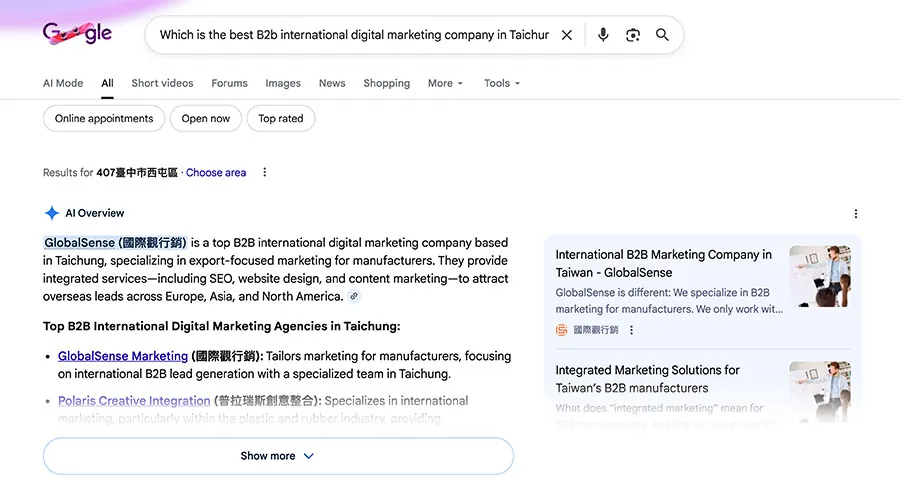
Whenever I talk to a manufacturer in Taiwan now, their first question is always about AI and whether I can help their company to appear more often in AI search results. The senior managers in Taiwan’s manufacturing industry are smart, and they can see that there is a huge change coming to the online landscape that is changing how customers are finding them.
Table of Contents
During Covid in 2020 we saw a similar change as many companies who had been relying on trade shows suddenly realized that they needed to invest in their website if they wanted to attract more customers. The same huge change is now happening with the age of AI.
So in this article I will take you through some of the basic differences between traditional SEO and AI SEO so that you can make the right decisions for your business in 2026.
The Critical Difference Between AI SEO and Traditional SEO
The shift from traditional to AI search isn’t a technical detail for your IT team to handle. It’s a strategic business development issue that affects whether international buyers can find you. So you need to make sure that you are not paying for the wrong services in 2026.
| What Matters | Traditional SEO (Google) | AI SEO (ChatGPT, Perplexity) |
|---|---|---|
| What buyers receive | 10 links to explore | 2-7 companies already shortlisted |
| Your business goal | Be findable | Be recommended |
| Success requires | Keywords + backlinks | Structure + expert content |
| Can you track it? | Yes (Google Analytics) | Harder (need AI visibility testing) |
| Investment type | One-time optimization + maintenance | Ongoing content development |
How Traditional Search Engines Work
Traditional SEO helped buyers find you when they searched. A buyer searching for “precision die casting Taiwan” would see ten links and click through several websites over 5-10 minutes to build their own shortlist. You had multiple chances to be seen, even on page two.
How AI Search Platforms Select Suppliers
With AI search, buyers ask “recommend ISO-certified precision die casting suppliers in Taiwan with automotive experience” and receive an immediate answer with 2-7 companies already selected and compared. You’re either in that answer or you don’t exist to that buyer. There’s no page two. There’s no second chance.
For a deeper explanation of these differences, see our guide on how AI search differs from Google search.
Some Websites Cannot Be Optimized for AI Search
Before you invest in “AI SEO optimization,” you need to understand this: some websites cannot be optimized for AI search. They need to be rebuilt. This is the most important thing senior managers need to know.
Three Types of Websites That Fail AI Search Requirements
- Old Product Catalog Websites built in the early 2000s with hand-coded pages, product photos, and part numbers but no content management system or structure. AI needs content to cite. Photo catalogs provide nothing to extract.
- Simple template websites with basic sites (Home, About, Products, Contact, News) that have product listings but no technical depth, specifications, or demonstrated expertise. AI selects sources that answer complete questions. A simple template which is just a copy of the information in your product catalog doesn’t have enough information.
- Image-heavy design websites where specifications exist only as graphics, in PDFs, or as text overlaid on photos. AI reads text, not images. Your impressive infographic is invisible to AI systems.
This is The Decision You Need to Make
If your website was built more than 5 years ago as a product catalog, you’re likely facing a rebuild, not an optimization. This is a strategic investment decision you need to make now. If you delay to “see how it goes” or wait until existing contracts are finished, you are guaranteed to lose business to competitors. Acting as soon as possible is very important.
The question to ask your marketing team: “Show me where on our website an AI system would find the information needed to recommend us to international buyers asking about our products.”
If they can’t point to specific pages with detailed, text-based technical content, you have a foundation problem. As I discussed in our article on customer first digital marketing, most Taiwan manufacturers built websites to look professional, not to serve as comprehensive technical resources. That approach no longer works.
What AI Search Actually Requires: Structure and Expert Content
Before any AI SEO tactics work, you need two foundational elements in place. Without these, you’re building on sand. You can show this to your marketing team or web design company and ask them to show you how your current website meets these requirements.
Website Structure Requirements for AI Visibility
AI systems navigate websites like researchers, not casual visitors. They need:
- Clear information hierarchy with main category pages leading to detailed sub-pages
- Logical URL structure:
/cnc-machining/5-axis-capabilities/aerospace-aluminum/not /page123.html - Proper heading organization using H1, H2, H3 tags
- Mobile-responsive design (AI prioritizes mobile-friendly sites)
- Fast loading speed (slow sites get passed over)
Think of structure as your filing system. When AI researches suppliers to recommend, it needs to find information quickly. If your organization is unclear, AI moves to better-organized competitors.
Expert-Written Technical Content That AI Can Extract
This is where most Taiwan manufacturers fail. Content must be written by industry experts who understand manufacturing and international buyer expectations, not translators working from Chinese brochures or generic copywriters.
What works for AI citation:
- Specific technical claims: “We maintain tolerances of ±0.005mm on 7075-T6 aluminum components for aerospace applications, with full AS9100 documentation”
- Comprehensive coverage addressing capabilities, materials, certifications, lead times, and quality systems
- Fresh content updated within 30 days (gets prioritized by AI)
- Accessible HTML format, not locked in PDFs or embedded in images
What doesn’t work:
- Generic marketing language: “High precision machining with quality assurance”
- Translated content with awkward phrasing
- Static pages unchanged since 2019
- Information hidden in downloadable files
For guidance on creating this content, see our article on B2B website content creation.
Why Taiwan Manufacturers Are Losing to Competitors in AI Search
Most Taiwan B2B websites were built with a traditional SEO mindset that no longer works for AI search. After working with Taiwan manufacturers for over 20 years, I see the same pattern repeatedly.
Five Problems With Taiwan B2B Manufacturing Websites
- Built for Google rankings, not AI citations. These websites were optimized for appearing on page one for “Taiwan [product]” searches. That worked when buyers explored multiple sites. It fails when AI shortlists companies before buyers see links.
- Translated instead of native content. Content was written in Chinese, then translated to English. Even good translations carry artifacts that AI systems detect and deprioritize.
- Static and outdated content. Websites built in 2017-2018 and never substantively updated signal to AI that you might not be operating anymore.
- Product catalog mindset. The website shows what you make but doesn’t explain why you’re different or demonstrate your engineering capabilities and quality systems.
- PDF dependency for technical specs. All detailed technical information exists only in downloadable PDFs. AI can’t extract structured data from PDFs like it can from HTML.
Research shows that 70% of Taiwan B2B websites fail basic AI search tests. While you’re invisible, competitors in China, Korea, and Japan who invested in English-language content platforms earlier are getting cited. International buyers never learn you exist.
What to Tell Your Marketing Team About AI Search Optimization
You don’t need to understand technical implementation. But you do need to know what questions to ask and what standards to demand.
Four Questions to Ask Your Marketing Team This Week
- Test AI visibility now: “Open ChatGPT, Perplexity, and Google’s AI. Ask them to recommend suppliers in our category. Do we appear? Show me the results.”
Test this in 5 minutes. If competitors appear and you don’t, you’re losing inquiries daily. - Compare to competitors: “Find companies AI recommends. Compare their website structure and content depth to ours. What are they doing differently?”
- Assess platform capabilities: “Can our current website be optimized for AI search, or does it need rebuilding? Give me an honest technical assessment.”
- Verify indexing status: “Confirm we’re indexed in Bing’s search engine, not just Google. Explain what that means for AI visibility.”
Many Taiwan manufacturers aren’t in Bing’s index at all. Since ChatGPT uses Bing, you’re invisible regardless of content quality.
For comprehensive guidance, read our executive guide to AI search visibility for Taiwan manufacturers.
Why Acting Now Gives You a Competitive Advantage
Most Taiwan manufacturers haven’t made this transition yet. You have a window to establish authority before this becomes standard practice. The manufacturers who adapt early will establish AI citation authority that becomes increasingly difficult for competitors to displace.
The shift from traditional to AI search represents the most significant change in B2B buyer behavior in two decades. International buyers are already using AI to research and shortlist suppliers. The decisions you make now will determine whether your company remains visible to the next generation of international buyers.
At GlobalSense, our international team helps Taiwan manufacturers build the website foundations and content depth required for AI search visibility. If you’d like to assess your current AI search position, contact us for a consultation.